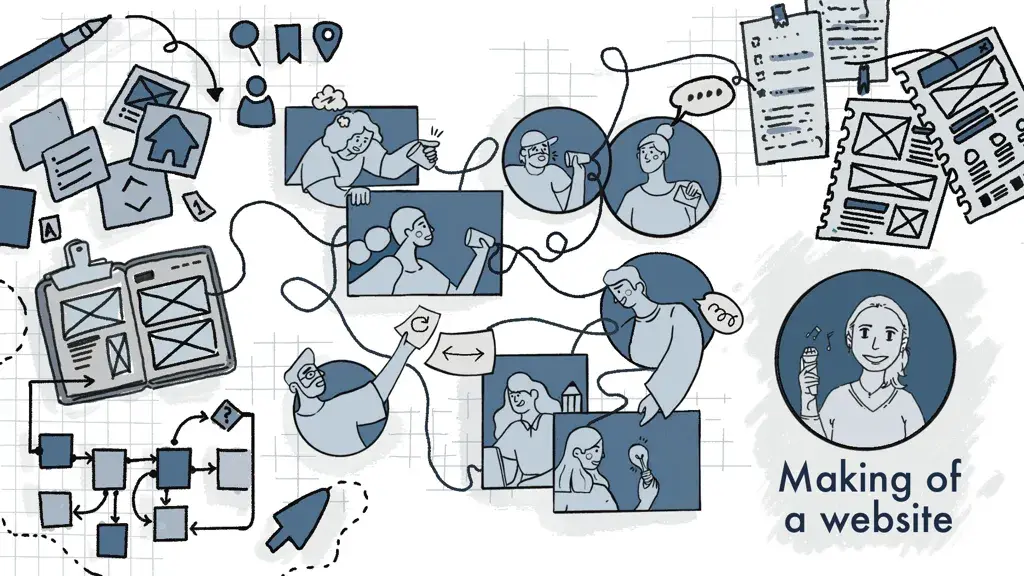
Making of a Website
22 September 2026

One fine day, my mentor asked me if I, along with Arundhati, our graphic designer, could take up the task of revamping our old website. I knew that the website had not been updated in the last three to four years, and many people had suggested that we refresh it. At the time we were handling multiple large-scale projects with a small team of designers, and everyone was focused on fulfilling client requirements and deadlines, which is why updating our own website although the need was clear, always remained on the back burner.
Since the day I joined Sarg, I had always wanted to work on the website revamp. As admin head, I had already received several suggestions regarding our website and how our newer, bigger projects were not visible online which led to some confusion with regard to what we exactly did, which is why, when the request came in, without giving it a second thought I said yes. When I agreed to take this project, I had completed about a year at Sarg. Although I was genuinely excited about the opportunity, what I did not realize at the time was how deep, detailed and chaotic the design process is. Looking back, that simple "yes" was the start of a new learning experience.
This was my first time leading a creative project of this nature working closely with designers on a common objective. I did not have a background in graphic design, marketing, UI/UX, or web development, yet, I had stepped into a role where I would need to understand what each discipline entails and more importantly how they collaborate.
As the work began, I immediately realized that a website is much more than a collection of pages and images. Behind every screen and button, laid a series of discussions and exercises. Countless small details, that a person cannot think of single-handedly. My personal learning journey started with a term I had never heard before, the wireframe. Little did I know that this would be my first step into a world of design thinking, user experience, content planning, and collaboration. As I was unfamiliar with the whole process, when it began, I was left puzzled about where I should begin. My mentor had instructed me to take all the help I need from designers for content and design and had specifically assigned people to support the project. However, I soon realized that having resources and knowing how to utilize them effectively are two very different things.
Our first review with our mentor was a complete failure. We skipped steps and directly implemented changes without clear ideations. The software system we were using to implement the same was also not working well. This review gave me us a huge and necessary reality check.
Instead of getting discouraged, I decided to absorb and learn from this setback. With the support of my colleagues, I started studying websites of organizations like ours and those from different industries. We discussed what worked well, what did not, what we wanted included to our website, and what we wanted to avoid. Slowly, our ideas started taking shape. We began by compiling our thoughts into presentations followed by rough sketches on paper, leading to wireframes and layouts on Figma. What initially began as a simple website revamp gradually turned into the complete restructuring of the website.
We went through the website tab by tab, page by page. For each section, we discussed the purpose behind adding something or modifying existing content. The thing that stuck with me was that intent is the most important thing in design followed by content, images, and overall presentation. We started collecting our project images and references for the graphic designers who contributed with fantastic sketches, illustrations, animations, and visual ideas that brought the content to life and narrated a story.
Gradually, the website began to reflect what Sarg truly is, a highly creative design studio.
Throughout this process, I learned how different disciplines work in unison. I started understanding the roles of UI/UX, graphic design, content development when building a website and how closely they depend on each other. Every single discussion, review, and revision taught me something new.
With each round of feedback, I became more familiar with the overall management and decision-making process behind any project. I learned what role stakeholders hold and how in design it is essential to put ourselves in other’s shoes and be critical of our own work for us to truly improve. I looked at the website from different perspectives, the client's perspective, a job applicant's perspective, and the internal team's perspective.
When the creative team had built its foundation, the developer was onboarded to the project. At this point I started understanding the technical aspect and practical challenges involved in bringing designs to life. The challenges were not just limited to the front end. Managing the backend structure, organizing folders, and ensuring that multiple people could work smoothly on shared files became a challenge. Since many team members were contributing simultaneously, maintaining order and coordination became one of my key responsibilities.
Every input from every side, opened a new train of thought. Each review pushed us back to the drawing board and deeper into research. There were countless discussions and conversations on every aspect of the website; content, graphics, layouts, navigation, and sometimes the smallest factor like a single comma in a sentence. What I truly learned from this experience was the value of multidisciplinary design approach. Communication and discussion with all the involved fields are essential in any kind of projects to truly refine or optimise something. Nothing existed in isolation. Content depended on design, design depended on user experience, user experience depended on technical feasibility, and every uninformed decision affected something else. Which is why all the necessary people had to work together like one single melting pot.
One of the most important aspects of the project was the involvement of our senior managers. From the very beginning, they were actively engaged in shaping the website. They reviewed concepts, challenged assumptions, provided direction, shared their experience, and ensured that every section aligned with Sarg's vision and values. Whenever we reached a dead end, their feedback helped us move forward.
Many of the critical decisions that shaped the final website emerged from these discussions and reviews.
As I mentioned before we are a relatively small team and everyone was already occupied with client projects. Yet, people took time from their busy schedules to contribute to the website. Designers, developers, managers, and team members from different disciplines, all played their part.
After months of discussions, reviews, redesigns, content revisions, technical implementation, and countless iterations, the website finally went live.
Looking back, I realized that this project brought something to life; Something that I had learnt during my management education - to manage something well, you cannot remain at the surface; you need to understand it's nuts and bolts and get close to the ground level work. For me, that meant learning what each discipline actually does, understanding why every decision was being made, and seeing how one small change could affect something else like dominoes. I learnt that having resources and knowing how to utilise them effectively are two very different things. The more I understood the work, the better I could coordinate, ask the right questions and make informed decisions.
Perhaps, managing begins with understanding and perhaps; to truly understand the larger picture, you first have to notice the finer details. Very much alike assembling a puzzle by observing every single piece and how it fits.
- Kranti, Sarg Design Studio